
Why does finding one fact take so long?
A single patient referral pathway might hold a GP letter, a diagnostic XLSX, a clinic letter, and a scanned form. Staff search each file manually — no cross-document query, no citation, no audit trail.
Dossier lets NHS-commissioned organisations query sensitive patient documents in plain English, with every answer traced to its source and every query logged for CQC-ready governance.
Grounding rate, NHS POC*
Time to Ready across all file types
Supported document formats
Managed engagement window
Patient referral pathways, diagnostic results, clinic correspondence, and compliance records — spread across formats nobody designed to work together. The NHS POC is at nhs AI patient data private secure governed.
A single patient referral pathway might hold a GP letter, a diagnostic XLSX, a clinic letter, and a scanned form. Staff search each file manually — no cross-document query, no citation, no audit trail.
Dossier ingests every file in the set — regardless of format — and answers plain-English questions across all of them, returning the exact value, the source document, and the specific page or tab.
Every query, every answer, and every citation is logged. BureauGovern processes that log into a CQC-ready governance record — without anyone filing anything separately.
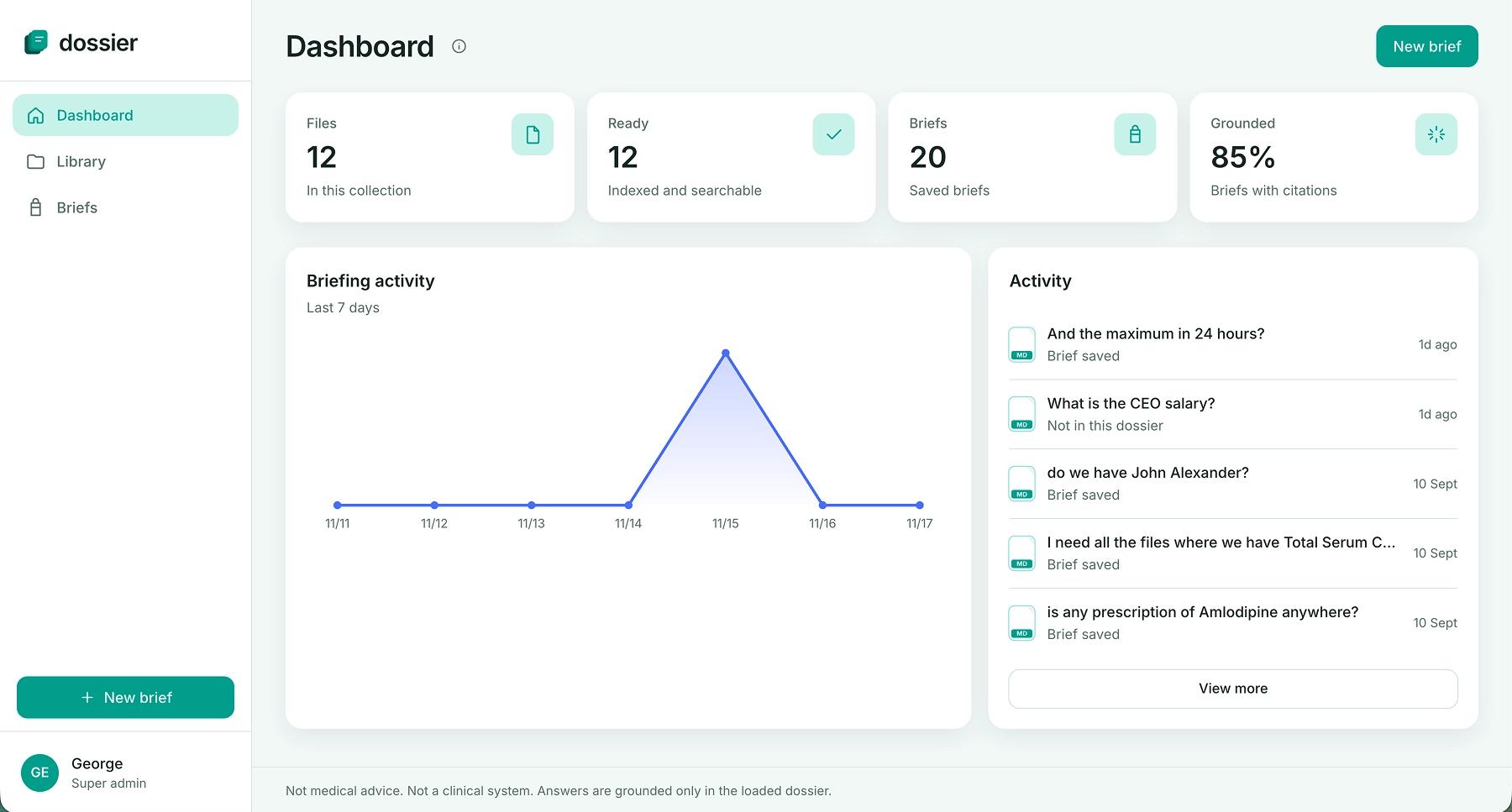
A document intelligence platform built for NHS administrative environments — multi-format ingestion, natural-language querying, and automatic governance. Click any screen to enlarge.
Document Library
All formats at Ready status
NHS admin teams currently spend significant time searching documents manually, with no citation trail and no governance record. Dossier replaces that process with a governed, grounded alternative. The model beside this ledger turns documents reviewed per day into hours recovered and the value of that time.
Weekly hours recovered
10hrs
Time value / yr
£19,200
Fee / yr
~£9,000
Return on fee
113%
PDF, DOCX, XLSX (multi-tab), Markdown, image files, and scanned forms — all ingested without manual conversion.
Every answer includes the source document and page reference. One click opens the source preview, including highlighted rows in spreadsheets.
Every query, answer, citation, and timestamp is captured. No separate governance filing required.
Every step produces a verifiable, logged output — from document ingestion to CQC-ready governance record.
GP letters, diagnostic PDFs, XLSX workbooks, and clinic correspondence are uploaded together and reach Ready status within two minutes, regardless of format.
The admin types a natural-language query — is there a cholesterol reading, a referral from a named clinician, an X-ray in this file — directly into the Briefs interface, no search syntax required.
Dossier returns the exact value, the document name, and the specific page or tab — the source preview opens in one click, including the highlighted row in a multi-tab spreadsheet.
A second question continues in the same Brief, with suggested follow-ups generated automatically; the full exchange is saved as a named record with its complete citation trail.
Every query, every answer, every citation, and every timestamp is logged and processed by BureauGovern into a structured record — ready when a commissioner or CQC inspector asks how the organisation uses AI with patient data.
05 / 05
Fig. 05-A — Upload → Query → Answer → Cite → GovernAuto-rotating / click to pin
These figures are the context for the NHS POC. The 85% grounding rate is observed testing data from September–November 2026. Time-to-Ready under two minutes was confirmed across the supported file types.
85%
Percentage of saved Briefs carrying at least one document-level citation, confirmed in live pilot with an NHS-commissioned CIC.
Source: TAB POC data, September–November 2026
48.7%
Nearly half of healthcare Google queries now return AI-generated answers — ungoverned AI use in NHS settings is increasingly visible to patients, commissioners, and regulators.
Source: BrightEdge Research, 2024
£6.6bn
NHS England's own review estimates over £6.6bn spent on administrative functions annually — document retrieval and manual search represent a material share of that burden.
Source: NHS England, National Review of Administrative Efficiency, 2022 (adjusted to 2026 values)
Real UK engagements. Named operators. Measurable outcomes — so the 14-day probation isn't a leap of faith.
No internal IT team required. TAB manages setup, hosting, maintenance, and support. The onboarding process follows four steps.
Scope the document library, agree file naming conventions, confirm the data processing agreement, and set up access credentials.
Existing document sets are uploaded. All formats — PDF, DOCX, XLSX, images, and scanned forms — reach Ready status automatically. No manual conversion required.
The team runs their first real queries against live documents. Plain-English training takes under an hour. No search syntax or field mapping to learn.
The governance module is configured. AI tool register populated, policy templates applied, audit log live. CQC/ICB-ready documentation begins accumulating from day one of live use.
Every answer Dossier returns is traceable to a source document, page, and tab. If a query returns no result, it returns "Not in this dossier" — not a hallucination. If you find a confirmed hallucinated positive in your document set within the first 90 days, we will review it at no charge and issue a credit.
Every Brief can be reviewed, exported, and shared by a human before any action is taken. AI answers inform decisions — they do not make them.
Ten questions NHS admin teams, commissioners, and CQC-aware decision-makers ask before deploying Dossier.
Dossier is a document intelligence tool for administrative use in NHS-commissioned organisations. It retrieves and cites information from documents uploaded to it. It does not connect to patient record systems, does not generate clinical recommendations, and explicitly disclaims medical advice in every interface. It is not a clinical system.
No. It is a document intelligence tool for administrative use. It retrieves and cites information from documents uploaded to it. It does not connect to patient record systems, does not generate clinical recommendations, and explicitly disclaims medical advice in every interface.
On TAB-managed, UK-based infrastructure used by NHS-commissioned organisations. No patient data is transmitted to third-party AI providers in raw form. No document content is used for model training. A full data processing agreement is in place aligned with NHS information governance and UK GDPR requirements.
On TAB-managed, UK-based infrastructure. No patient data is transmitted to third-party AI providers in raw form. No document content is used for model training. A full data processing agreement (DPA) is in place aligned with NHS IG and UK GDPR requirements.
When the answer is not in the uploaded set, Dossier returns "Not in this dossier" for NHS-commissioned organisations. It does not draw on general model knowledge to fill gaps. That behaviour was tested explicitly and treated as a pass or fail criterion in the live NHS proof of concept.
The system returns "Not in this dossier." It does not draw on general model knowledge to fill gaps. This was tested explicitly and treated as a pass/fail criterion in the POC.
For NHS-commissioned organisations, BureauGovern produces an audit trail review, risk classification of AI-assisted decisions, NHS IG-aligned policy templates, and a readiness report formatted for CQC inspection or ICB commissioner review. The record accumulates from live Dossier use rather than a separate filing exercise.
An audit trail review, risk classification of AI-assisted decisions, NHS IG-aligned policy templates, and a readiness report formatted for CQC inspection or ICB commissioner review.
Yes. Dossier was designed for NHS-commissioned organisations such as a CIC or PCN without an internal IT team. TAB manages hosting, maintenance, updates, and support. The client required no internal engineering resource to go live, and onboarding took days rather than a long internal programme.
Yes — this is the model it was designed for. TAB manages hosting, maintenance, updates, and support. The client required no internal engineering resource to go live. Onboarding took days.
Dossier supports PDF, DOCX, XLSX including multi-tab workbooks, Markdown, and image files via vision model extraction — all confirmed in the POC with NHS-commissioned organisations. Additional formats are assessed on request as part of the managed service rather than assumed at launch.
PDF, DOCX, XLSX (multi-tab), Markdown, and image files via vision model extraction — all confirmed in the POC. Additional formats are assessed on request.
Yes. For NHS-commissioned organisations, each Brief supports multi-turn questioning in a single thread, with follow-up prompt suggestions generated automatically. The full exchange is saved as a named record with its complete citation trail, so later questions stay on the same governed thread.
Yes. Each Brief supports multi-turn questioning in a single thread, with follow-up prompt suggestions generated automatically. The full exchange is saved as a named record with its complete citation trail.
The grounding rate is the percentage of saved Briefs that contain at least one document-level citation. The POC with NHS-commissioned organisations observed 85 percent. In that environment, an AI answer that cannot be traced to a source document is not governance-compliant. Grounding is the operational measure of that standard.
The grounding rate is the percentage of saved Briefs that contain at least one document-level citation. The POC observed 85%. In an NHS-commissioned environment, an AI answer that cannot be traced to a source document is not governance-compliant. The grounding rate is the operational measure of that standard. Full write-up: nhs AI patient data private secure governed.
The deployment for NHS-commissioned organisations was designed to sit within DSPT assurances. All document processing occurs on TAB-managed, UK-based infrastructure under a full DPA. No patient data is transmitted to third-party AI providers in raw form. No document content is used for model training. DTAC alignment and DSPT compatibility sit in the managed service scope.
The deployment was designed to sit within DSPT assurances. All document processing occurs on TAB-managed, UK-based infrastructure under a full DPA. No patient data is transmitted to third-party AI providers in raw form. No document content is used for model training. DTAC alignment and DSPT compatibility are part of the managed service scope.
Document intelligence means Dossier only knows what is in documents uploaded by NHS-commissioned organisations. It does not draw on external model knowledge to fill gaps. When a record is not present, it returns "Not in this dossier" rather than a plausible-sounding answer, so every citation stays verifiable.
Document intelligence means the system only knows what is in your uploaded documents — it does not draw on external model knowledge to fill gaps. Unlike a general-purpose AI chatbot, Dossier cannot answer a question from outside your dossier. When a record is not present, it returns "Not in this dossier" explicitly rather than generating a plausible-sounding answer. This makes it governance-safe: every answer is grounded in your own documents, every citation is verifiable, and the system cannot produce unverifiable clinical content.
Book a demo or run the time-saving calculator to see what Dossier returns to your team each week.