
01Renewals
Expiry lists chased before the final week
AI contacts the client for updated sums insured, claims, and documents against the expiry date the broker entered. It does not recommend a product or invite a lapse decision.
UK insurance brokers are using AI to chase renewals and draft client emails, but only 20% of AI-using finance and insurance firms have a formal written policy. The FCA applies the Consumer Duty and the Senior Managers regime to AI the firm uses. Authorised staff remain responsible for recommendations, binding, and customer outcomes. For a managed deployment: Managed AI for UK insurance businesses.
of AI-using finance and insurance firms have a written policy
of digitised finance and insurance firms use AI
of AI-using UK firms have a formal written policy
AI product · BrokerOS
Motor disclosure documents checked on arrival — mismatches routed to your team before client contact.
Explore BrokerOS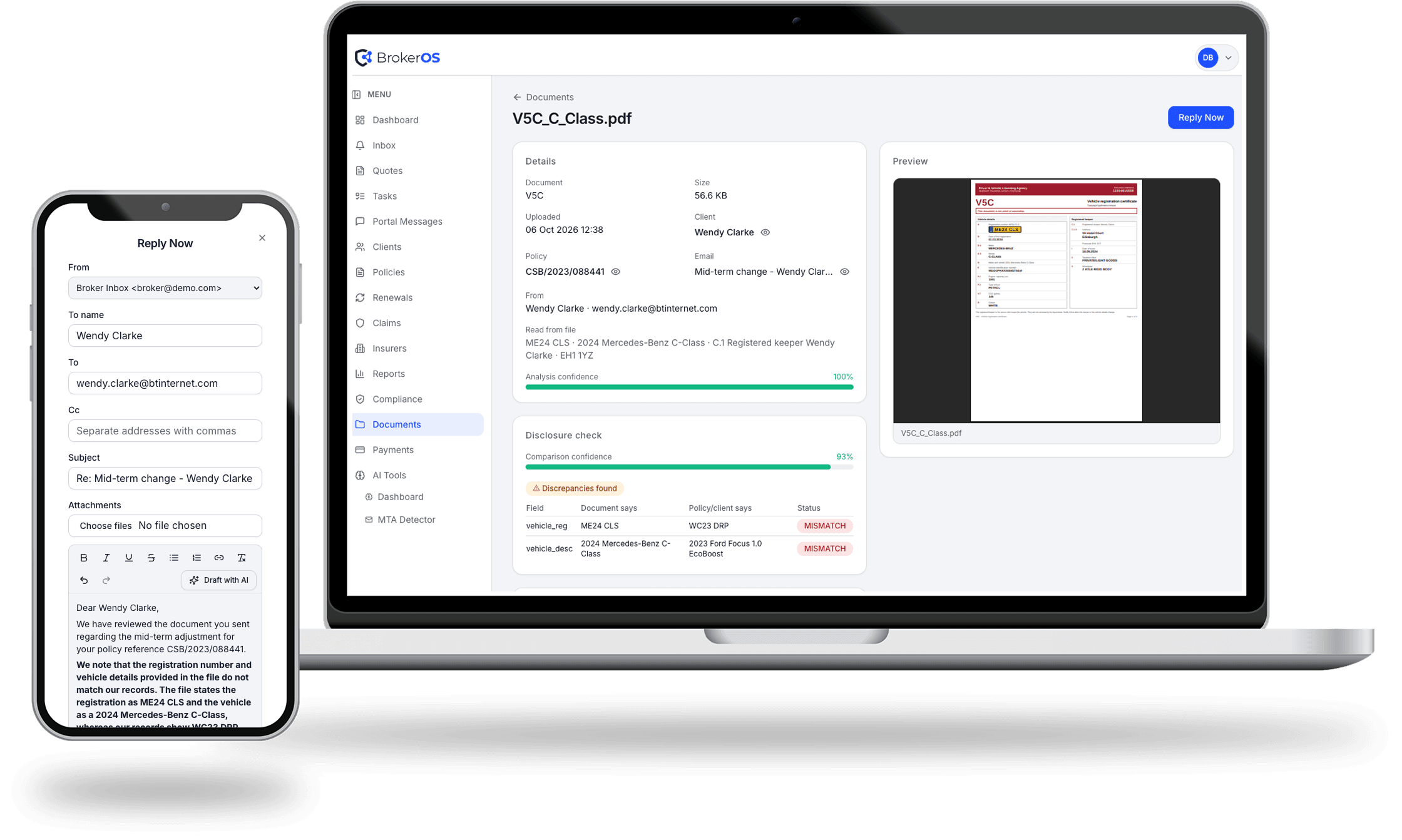
Insurance brokers are FCA-authorised firms. The Consumer Duty requires them to act in good faith and avoid foreseeable harm, including at renewal. A senior manager stays accountable for the firm's systems. The FCA does not certify AI products. Pasting a claims history into a public chatbot can breach confidentiality, and an unchecked draft can read as a recommendation. A written policy and a human check before send are how a broker shows those duties.
AI contacts the client for updated sums insured, claims, and documents against the expiry date the broker entered. It does not recommend a product or invite a lapse decision.
AI records the trade, the inception date, and the contact details from a call or web form, and routes anything that needs a quote to an authorised handler.
AI requests the missing proposal, claims experience, or schedule until the file is ready for a handler. It does not bind cover or issue a document of insurance.
AI keeps a record of what was asked, when the client replied, and which handler reviewed the note, so a Consumer Duty file is not reconstructed from inboxes.
This comparison is an account handler's week on a book of renewals: one expiry that has not been touched, one prospect who called while a placement was being finished, one proposal still missing a claims print, and one customer note that would not survive a file review. The manual column is inbox work between placements. The assisted column is the same chase captured and logged for an authorised person. No lapse-rate figure is invented here.
Industry risk profile
Estimated avoided breach cost
£2,325
Breach probability
15%
Deadline costs
£2,400
Total benefit / yr
£7,725
Recommendations, quotations, and binding authority stay with authorised staff.
Acturis, Open GI, Applied, and similar systems remain the client record.
Contact and review are logged so a file can be explained later.
TAB's managed service for an insurance broker is the admin layer the FCA expects the firm to control: renewal chase, enquiry capture, document collection, and a log of customer contact. Managed means TAB configures the advice boundary with a senior manager, hosts the work on UK infrastructure, and keeps the sequences running. The FCA does not certify vendors. Recommendations, binding, and Consumer Duty judgements stay with authorised staff. The brokerage does not hire a technician.
Chases go out against the dates in the book, asking for facts and documents. Product choice stays with the handler.
Claims histories and proposal answers are not the input to a public chatbot. The working method is a closed, UK-hosted workflow.
Each chase and each human review is recorded, which is the evidence the Consumer Duty asks a firm to be able to show.
04 / 04
Fig. 05-A — Stack compatibilityAuto-rotating / click to pin
A managed AI agent is named capacity for a desk of work—reception, follow-up, credit control, compliance, and more. It connects to your existing tools, runs under human oversight, and sits on a UK-managed monthly plan.
Unlike basic automation or self-serve AI tools, a Bureau AI agent is configured to your workflows, handles that desk autonomously, and works alongside your team so specialists stay on delivery—not on the chase, log, and update loop.
Managed AI agents grasp context, nuance, and intent—not just keywords. They handle real desk work, follow your terminology, and escalate when judgement is needed.
They connect to the tools you already run—Xero, HubSpot, Slack, Gmail, and your CRM or telephony stack. No rip-and-replace platform and no DIY API project to go live.
Every managed AI agent works under human supervision. Your Bureau contact reviews edge cases, adjusts scope, and keeps quality on track—not a self-serve black box.
They improve from feedback and from how your business actually operates. Desk capacity compounds over time—so the same agent handles more of the loop your specialists should not be doing.
Renewal chase, enquiry capture, and proposal-document collection. Recommendations and binding stay with authorised staff.
The measurable picture for UK insurance brokers is adoption inside a regulated sector that still rarely has a formal written AI policy. Finance and insurance firms use AI more than many other sectors, and one in five of those already using it report a written policy. TAB scopes renewal chase and enquiry capture against that gap, not against an invented lapse-rate claim.
20%
Among finance and insurance businesses that use AI, 20% reported a formal written policy, higher than real estate or professional services and still a minority.
Source: DSIT, UK Business Data Survey 2026, finance and insurance sector (businesses using AI).
48%
Of UK businesses that handled digitised data, 48% in finance and insurance said they used AI in 2025–26.
Source: DSIT, UK Business Data Survey 2026, figure 14.
5%
Nationally, 5% of businesses that use AI reported a formal written policy and 12% reported informal guidance.
Source: DSIT, UK Business Data Survey 2026, section 3.4.
Industry risk profile
TOTAL ANNUAL BENEFIT
£13,725
Net annual benefit
£8,925
ROI
186%
Model combines 55% admin reduction, expected breach avoidance (based on risk profile), and eliminated consultant callouts. Actual results depend on regulatory intensity and compliance discipline. Not financial advice.
Real UK engagements. Named operators. Measurable outcomes — so the 14-day probation isn't a leap of faith.
Big-budget automation programmes and enterprise rollouts often stretch for months before teams feel the benefit. Your managed AI agents can go live in about 14 days. Our managed onboarding protocol works alongside your existing tools and workflows—so day-to-day disruption stays low and your stack is not replatformed overnight.
We map your SOPs, tone of voice, and escalation protocols.
We configure the assistant's knowledge base to support your team's workflows and culture.
You test the assistant in a safe, offline environment.
The assistant receives live login credentials and begins work.
Deploy your managed AI agent today. If, after 14 days, you do not see a tangible reduction in workload, we will offboard the assistant and refund 100% of your first month's invoice. No tribunals, no questions asked.
Every assistant comes with dedicated account management and human oversight. These aren't faceless bots—they're part of your team, backed by ours.
Yes. FCA-authorised brokers remain responsible for customer outcomes and for the systems they use, including AI. A written policy shows which tools are approved, what customer data may enter them, and who checks an output. The UK Business Data Survey 2026 found a formal written policy at 20% of AI-using finance and insurance firms.
Yes. Brokers are FCA-authorised, and the Consumer Duty plus the Senior Managers regime apply to the systems the firm uses, including AI. A written policy is how the firm shows which tools are approved, what customer data may enter them, and who checks an output before it is sent. The UK Business Data Survey 2026 found that 20% of AI-using finance and insurance businesses had a formal written policy. Nationally the figure for any AI-using business is 5%.
Brokers may use tools the firm has risk-assessed and contracted. The FCA does not approve products. Identifiable customer or risk information should not be pasted into a public chatbot. A closed system, a processing agreement, and a handler check before anything could be read as a recommendation are the working standard. Binding stays with authorised staff.
Brokers can use tools the firm has risk-assessed and contracted. The FCA does not approve products. Customer information that identifies a person or a risk should not be pasted into a public chatbot. A closed system with a processing agreement, UK hosting where the file requires it, and an authorised handler checking anything that could be read as a recommendation are the practical standard in 2026. Binding authority does not move to the tool.
The FCA does not certify AI vendors and has not created a separate AI permission. The Consumer Duty and the Senior Managers regime already apply to systems the firm uses, including at renewal. An AI draft that recommends a product or confirms cover is still the firm's communication. Admin chase is a different activity from advice.
The FCA has not created a separate permission for using AI and does not certify vendors. It expects existing rules to do the work: the Consumer Duty on customer outcomes, including renewals, and the Senior Managers regime on who is accountable for systems. An AI draft that recommends a product or confirms cover is still the firm's communication. Authorised staff have to be able to explain it. Admin chase and logging are a different activity from advice.
UK brokers are using AI to summarise emails, draft renewal chasers, and assemble facts before a remarket. The UK Business Data Survey 2026 found the most common uses were research and drafting correspondence. In a brokerage that time sits on the renewal book and on inbound enquiries. The decision to recommend or bind stays with authorised staff.
Brokers are using AI to summarise long emails, draft routine renewal chasers, and pull the facts a handler needs before a remarket. The UK Business Data Survey 2026 found the most common business uses of AI were researching information and drafting or summarising correspondence. In a brokerage that time sits on the renewal book and on inbound enquiries, not on the decision to bind. Of digitised finance and insurance firms, 48% said they used AI.
The sharpest risk is an unchecked draft that reads as a personal recommendation, or a customer schedule pasted into a public chatbot. Either can fail confidentiality or the Consumer Duty. A named tool list, a ban on raw customer data in public models, and a handler review before send are the matching controls.
The sharpest risk is an unchecked draft that reads as a personal recommendation, or a customer schedule pasted into a public chatbot. Either can fail the Consumer Duty or confidentiality, and a fluent error about cover is foreseeable harm. The control that matches the risk is a named list of tools, a ban on raw customer data in public models, and a handler review before send. The FCA will look at the firm's systems, not at the vendor's marketing.