
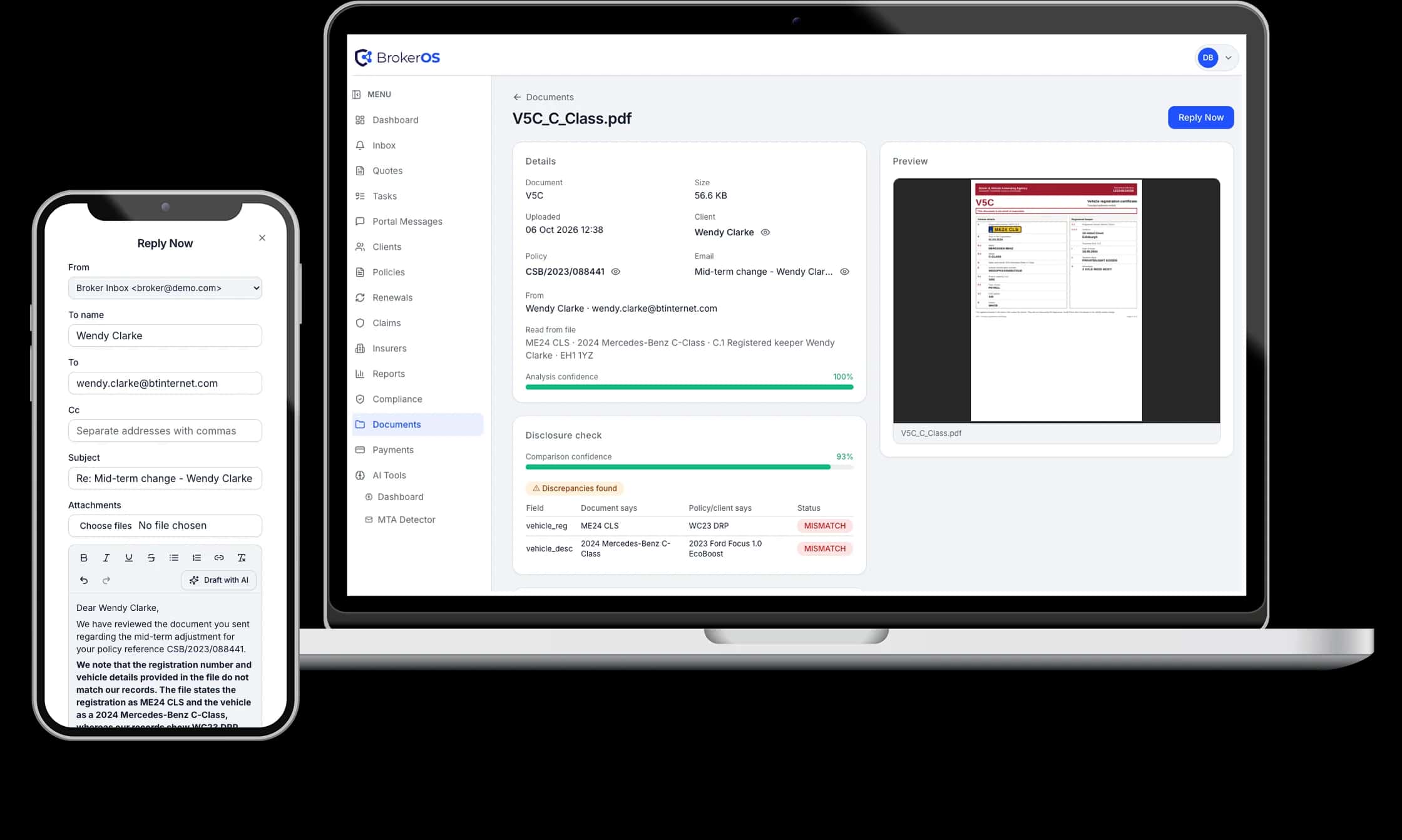
Every motor insurance broker receives them daily: a V5C for a new vehicle, a driving licence for a named driver, a no-claims certificate from a previous insurer, a proof of address. Each one needs to be opened, read, and checked against what the customer declared when they took out the policy. For a team handling forty or more emails a day, that is a significant portion of every working week — and the stakes are high. A missed mismatch does not just mean admin rework. It means a policy that pays out on a vehicle the insurer never agreed to cover. And the liability sits with the broker.
Reported outcome: ~21 hours* returned to a three-person broking team every week. Every inbound document now checked against the policy on file — automatically, before the inbox is opened.
See the full disclosure verification workflow — from inbox sync to mismatch flag to Reply Now.
|
Client |
Got You Covered |
|
Sector |
Motor insurance brokerage, UK |
|
What TAB deployed |
BrokerOS — AI disclosure verification, inbox integration, task automation, client reply workflow |
|
Engagement model |
Managed AI platform (BureauSuite™) |
|
Status |
Pilot live |
The problem
Motor insurance brokers in the UK process a constant stream of inbound documents from clients: V5Cs when a vehicle changes, driving licences for named drivers, no-claims certificates at renewal, proof of address for identity checks. Each document carries structured data — registration numbers, names, dates, postcodes — that should match what the customer declared when the policy was written.
The manual process is straightforward in theory: open the email, open the attachment, locate the client file, compare the fields, note any discrepancy, draft a reply, and log a task for follow-up. In practice, with a busy inbox and a small team, it is exactly the kind of work that gets done partially or deprioritised. And when a mismatch is missed, the consequences do not fall on the customer. They fall on the broker's PI cover.
Got You Covered's team was doing this manually. They were doing it carefully. But with the volume of documents they process each week, disclosure checking was consuming hours of structured attention — time that three experienced brokers should be spending on clients and growth, not on cross-referencing attachments against policy screens.
What the UK data says
The problem is not unique to Got You Covered. It reflects a structural challenge across the SME broking market.
|
Measure |
Detail |
|---|---|
|
30–501 |
Average inbound emails a day for a UK SME motor broker |
|
30–40%1 |
Estimated proportion containing a document that requires verification |
|
10–15 minutes1 |
Average manual check time per document |
|
15–25 hours1 |
Estimated team hours on disclosure checking per week, for three staff |
|
£4,000–£12,000+3 |
Average cost of a material non-disclosure claim |
FCA guidance under Consumer Duty requires brokers to demonstrate that customers have received fair treatment and that material information has been correctly captured and acted on.2 Manual processes introduce a risk that brokers cannot always demonstrate this — because checks are not always logged, are not always completed under time pressure, or were performed by someone who has since left the business.
The compliance risk and the operational cost land on the same desk.
Not just a motor broker problem
The disclosure verification challenge exists across the broking market wherever client circumstances can change between inception and renewal:
- Commercial vehicle fleets — multiple drivers, frequent licence updates, vehicle swaps.
- Home insurance — change of address, property modifications, new valuables.
- SME liability — staff headcount changes, business activity amendments.
- High-net-worth — asset additions, new named drivers, address changes.
What the Got You Covered deployment demonstrates is that the solution — an AI that reads every document the moment it arrives and compares it against the record — is deployable today, against a live inbox, in a working brokerage, without replacing any existing system.
What The Agent Bureau built
The brief was not to replace the team's judgement. It was to remove the reading, extracting, comparing, and drafting that sits below their expertise level — so their time could be spent on the decisions only they can make.
|
BureauSuite™ layer |
Status |
Shipped as |
|---|---|---|
|
BureauGovern™ AI Governance |
Live |
Audit trail, FCA compliance layer, human oversight on every AI-driven action |
|
BureauCRM™ Clients |
Live |
Client file, policy declarations, named drivers, vehicle register |
|
BureauRetention™ Policy |
Live |
Document intake, structured fact extraction, policy diff, mismatch detection, task creation |
|
BureauReach™ Outreach |
Live |
Reply Now, pre-addressed draft, one-click send directly from the task |
|
BureauSuite™ Platform |
Live |
Unified inbox, task queue, document library, sync-on-demand |
Layer 0 — BureauGovern™ — AI Governance
- Every AI action is logged with a timestamp, the data it acted on, and the broker who reviewed it.
- No automated client communication leaves the system without human review.
- The audit trail is retained for FCA record-keeping.
- Human oversight is the final step before anything reaches the client.
That is an evidence trail with human review — policy administration, not regulatory or legal advice.
Layer 1 — BureauCRM™ — Client and policy records
- The client file stores full name, date of birth, address, vehicle register and named drivers.
- The policy record stores declared values: vehicle registration, vehicle description, NCB years, inception date.
- These are the reference values every inbound document is compared against.
Layer 2 — BureauRetention™ — Disclosure verification
BrokerOS connects to the broker's existing mailbox — Microsoft 365, Gmail, or any SMTP setup — without replacing it. It reads every inbound email and attachment automatically on arrival. A manual sync is always available for an on-demand pull.
Structured facts are extracted per document type:
- V5C: registration number, make and model, registered keeper, postcode.
- Driving licence: full name, driver number, date of birth, address.
- No-claims certificate: policyholder name, years accrued, previous policy reference.
- Proof of address: address line, town, postcode.
Each extracted fact is compared against the client and policy record, field by field. Each field is assigned a status — MATCH, PARTIAL or MISMATCH — with the document value and the declared value shown side by side.
When any discrepancy is found, BrokerOS creates a high-priority DOC_REVIEW task automatically, with a plain-English summary of exactly what does not match and where.
Layer 3 — BureauReach™ — Client communication
Reply Now opens a pre-addressed reply draft directly from within the mismatch task. The draft references the specific discrepancy in plain language — no copying, no switching to Outlook, no hunting for the original email.
The broker reviews, adjusts if needed, and sends. The reply is logged against the task and the client file. The loop is closed.
The results
These figures are based on the Got You Covered pilot, using time estimates derived from the team's pre-deployment manual workflow and observed document volumes during the trial period.
|
Measure |
Detail |
|---|---|
|
~21 hours* |
Returned to the team per week, across three brokers — about 7 hours per person. |
|
<60 seconds |
From email received to mismatch task created. |
|
5 steps |
Manual steps eliminated per document — read, extract, compare, log, draft reply. |
|
4 document types |
Covered at launch — V5C, driving licence, no-claims certificate, proof of address. |
|
100% |
Human review retained. Every flagged mismatch is reviewed by the broker before any client contact. |
Time savings are estimated from pre-deployment workflow mapping. Audited figures will be published following the 90-day review. Note 4.
In their words
The client testimonial will be added at the 90-day pilot review.
What this demonstrates about TAB's managed service
- Inbox integration without disruption. BrokerOS connects to an existing Microsoft 365, Gmail, or SMTP mailbox. Nothing in the broker's current workflow is replaced or moved.
- Structured extraction from real broker documents. OCR and field mapping work at production quality on the document formats UK motor brokers receive every day.
- Field-level comparison, not keyword matching. The system compares registration numbers, names, and postcodes against the specific values declared on the policy — not summaries or categories.
- The broker does not find the problem. The problem finds the broker. Mismatches arrive as high-priority tasks with the summary already written.
- Reply Now closes the loop from one screen. From document received to client contacted, without switching applications or finding the original email.
- BureauGovern™ keeps every AI action auditable. The broker can demonstrate to the FCA that every disclosure check was run, logged, and reviewed by a human before any action was taken.
- TAB manages the platform. The broker team does not maintain, monitor, or update the AI. That is TAB's job.
Does this sound like your business?
You are likely a fit for this deployment if:
- Your team spends time each week manually checking documents against policy declarations.
- You process V5Cs, driving licences, no-claims certificates, or proof of address submissions regularly.
- You have had at least one instance where a mismatch was caught late — or was not caught at all.
- Your checking workload scales with email volume, not with process improvements.
- You want disclosure checks that are systematic, logged, and auditable.
The Agent Bureau builds and manages BrokerOS for UK insurance brokers: inbox-connected disclosure checks, human review before any client contact, and an audit trail on every AI action. TAB runs the platform. The broking team keeps the decisions. The same pattern sits behind the wider insurance broker desk — admin capacity, with placement and advice staying with authorised people.
Sources and notes
1. Average email volumes and document verification rates: indicative figures based on BIBA SME motor broker member surveys, 2024.
2. FCA Consumer Duty guidance on material information capture and fair treatment: PS22/9, July 2022.
3. Motor non-disclosure claim cost estimates: Association of British Insurers motor claims data, 2024.
4. Time savings: estimated from pre-deployment workflow mapping with the Got You Covered team. Subject to audited 90-day review.